Interactive Pinyin Chart
Click to hear Mandarin sounds, compare their tones, and discover Chinese characters and words that use them.
Initials
Lips
Tongue tip
Back of tongue
Front of tongue
Tip forward
Tip raised
Spelling helpers
Zero initial
Finals
Compatible options enabledSingle vowels
Vowel glides
Ends in -n
Ends in -ng
R-colored
an
Tones
b + an= ban
Tone 1
Keep your pitch high and level.
Tone 2
Start mid, then rise.
Tone 3
Go low. Rise in isolation.
Tone 4
Fall quickly from high.
The separate clips are pronunciation cues: blend them into one syllable. y and w are spelling helpers, illustrated with yi and wu. For example, iao is written yao without an initial.
Characters
Tone 1 · bān
Loading examples…
Tone 2 · bán
Loading examples…
Tone 3 · bǎn
Loading examples…
Tone 4 · bàn
Loading examples…
a, p, f, o, ai, en and eng preview recordings: Chen Wang / audio-cmn · CC BY-SA 3.0. Audio cleaned and volume balanced.
Mandarin pronunciation basics
Pinyin uses letters and tone marks to show how a Chinese character is pronounced. To read a syllable, look for the initial, the final, and the tone.
- Initial
- The consonant at the start of a syllable. Some syllables start without one.
- Final
- The vowel and any sounds that go with it, such as the n in an. A final can also stand on its own.
- Tone
- The pitch pattern you use as you say the syllable. In pinyin, the tone mark goes over a vowel.
Put the parts together
Read each breakdown, then listen and say the character as one syllable.
- 马horse
- Initial · m
- Start with your lips closed and let air out through your nose.
- Final · a
- Open your mouth straight into the vowel.
- Tone · 3
- The mark on ǎ tells you to dip and then rise when saying the character on its own.
- 我I / me
- Initial · None
- The w is part of the spelling. You start right on the final.
- Final · uo
- Start with rounded lips, then open them a little. On its own, uo is spelled wo.
- Tone · 3
- The mark on ǒ is the same as the one on ǎ in mǎ. Use the same pitch pattern.
About Pinyin Chart · Guides and FAQs
How to use this pinyin chart with audio
Choose an initial and a compatible final to build a Mandarin syllable, then listen and compare its tones. Explore the matching characters and words to connect what you hear with written Chinese.
For example, 中文 (zhōngwén, Chinese) contains two syllables. Explore zhong and wen separately, then use the word examples to hear each sound in context.
What it does
Listen to unfamiliar Mandarin sounds
Explore consonants such as j, q, x, zh, ch, and sh alongside Chinese vowels and endings such as ü, an, ang, and ong. Audio lets you hear the sound represented by each spelling. Keep the vowel ending the same while changing the starting consonant to explore how syllables differ.
Compare the four Mandarin tones
In Mandarin, pitch is part of a word’s pronunciation: mā in 妈 (‘mother’) and mǎ in 马 (‘horse’) have the same consonant and vowel but different tones. The tone buttons and pitch contours let you compare the first, second, third, and fourth tones on a selected syllable.
Connect Chinese word pronunciation to characters
A sound can appear in more than one character or word. Matching entries are grouped by tone beneath the audio, with the relevant syllable highlighted in each example word’s pronunciation. Open a character or word to explore its reading and meaning, then connect the written form with the sound you heard.
Use a pinyin chart when you know the spelling
If your textbook gives a pronunciation such as chong, the chart brings its starting sound, ending, and tones together. These parts are called the initial, final, and tone. Compatible endings stay available as you change the initial, and the resulting spelling appears next to the playback button.
Frequently asked questions
How do I find out how to pronounce a Chinese word?
If you have the written word, use the Pinyin Converter to see its pronunciation in letters with tone marks. You can then explore those syllables in this sound chart and compare their tones. Check the reading of the word as a whole, because some characters have different pronunciations in different words.
Pinyin Converter →Can I read Chinese words using English pronunciation?
Mandarin written in Latin letters uses pinyin pronunciation rules. Familiar letters such as q, x, and c represent Mandarin sounds that differ from their usual English readings. Listen to the audio to connect each spelling with its sound; the letters are a pronunciation aid, while the Chinese word itself is written in characters.
Is this sound chart for Mandarin or Cantonese?
This chart is for Mandarin Chinese. It uses Mandarin audio, syllable spellings, and tones. Use it when you want to hear Mandarin pronunciation, including while studying simplified or traditional characters.
How can I practise Chinese tones with audio?
Select a syllable and replay its tone buttons while keeping the consonant and vowel the same. Follow the pitch contour and say each version aloud after listening. The character and word panels show matching dictionary entries where available, connecting the tone you hear to examples in written Chinese.
Why do different Chinese characters sound the same?
Different characters can share a Mandarin syllable and tone. That is why a sound can lead to several matching characters or words in the chart. The word and sentence provide the context needed to understand which meaning is intended.
Can I hear a whole Chinese sentence read aloud?
Yes. Paste your sentence into Chinese Text to Speech to hear it read in Mandarin with pinyin and word highlighting. Use the sound chart to explore an individual syllable, then listen to the sentence to hear how words sound together.
Chinese Text to Speech →Blogs and further reading
In-depth articles covering the background behind this tool.
Pinyin basics · 9 min readWhat Is Pinyin? A Complete Guide for Chinese LearnersPinyin is the official romanisation of Mandarin, and it is not English. How the system works, which letters mislead you, and how to use it well.Read the guide →Pronunciation · 10 min readChinese Pronunciation: A Complete Guide to MandarinEvery initial, final and tone in Mandarin, with the mouth positions English speakers need and the contrasts that actually carry meaning.Read the guide →Pronunciation · 9 min readChinese Tones Explained: How to Actually Learn ThemThe four tones, the neutral tone, the sandhi rules that change them, and a training method that works better than repeating mā má mǎ mà.Read the guide →Pronunciation · 9 min read10 Common Pinyin Mistakes English Speakers MakeThe pinyin errors that survive years of study, why familiar letters cause them, and the specific drills that actually correct each one.Read the guide →
Last reviewed
Other Chinese Tools
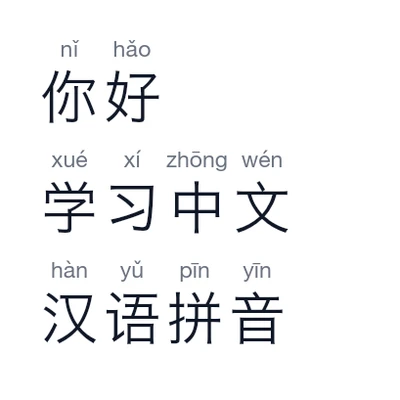
Pinyin Converter
Convert Chinese to pinyin, correct readings and copy or download
Open the tool →
Chinese Text to Speech
Hear Mandarin with pinyin and download audio or video
Open the tool →
Chinese Name Translator
See your name in Chinese with pinyin, audio, stroke order and a name card.
Open the tool →
Chinese Word Counter
Count Hanzi, words and punctuation in Chinese text
Open the tool →